— This blog post was written by Dr Claire Rachel Jackson, postdoctoral researcher in the Novel Echoes research group.
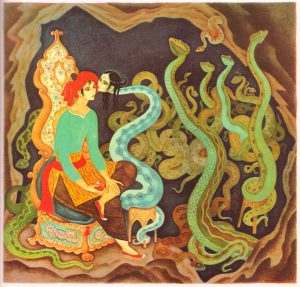 In Night 1 of my musings on the connections between the ancient novels and the Arabian Nights, I looked particularly at the story of Budur and Kumar, and how its narrative resembles ancient Greek narrative. Today I would like to continue by focusing on another of the tales from the Nights, about Yamilka Queen of the Serpents. In this story, a young woodcutter called Hasib, son of a Greek sage named Daniel, is abandoned in a forest by his (alleged) friends and meets the Queen of the Serpents, who tells her own tale (and several other inset stories) involving a society of apes, a magic ring, and human-animal hybrids.
A recent article by Richard van Leeuwen has suggested that there may be some overlap between this story and Iamblichus’ Babyloniaka, the fragmentary novel preserved primarily in a summary of the ninth-century patriarch Photius, an allusion which may be present even in the echo of Iamblichus in the name of the titular Yamilka.[1] But what’s most striking about both texts is the way they position themselves on the literary and geographical map. Iamblichus’ Babyloniaka is a text explicitly set on the very fringes of the Roman empire at its height – the very title ‘Babylonian Things’ aligns it with the ancient city of Babylon, itself a relic of a former age by the time of the novel. Although the geography of the novel is fuzzy, at least in Photius’ summary, it seems clear that the Babyloniaka was set entirely beyond the boundaries of the Roman Empire, in an exoticised and orientalised landscape, with virtually no Greek characters. As Helen Morales put it, ‘it is far from clear where to locate Greece in this ‘Greek novel’’.[2] This combination of Greek novel and non-Greek setting draws attention to the limitations of what a Greek novel can and should be, as well as the implied perspective of its audiences. In other words, the Babyloniaka uses its non-Greek setting to explore what Greekness means, both within the narrative and for its external readers.
You will never guess what happens next
The Yamilka narrative draws attention to similar questions, albeit in a different way. The whole tale involves an elaborate structure of inset narratives, analogous to the nesting-doll architecture of David Mitchell’s 2004 novel Cloud Atlas. But what’s notable here is how the levels of narration also correspond with the narrative’s movement across geographical spaces and into fantastical ones. As the inset narratives become more and more elaborate, the spaces they describe become correspondingly exoticised, with lots of human-animal hybrids, unreal landscapes, and bodies which split in half at the waist to go in different directions. Despite these surreal stories (and the fact that the narrator is half-woman, half-snake), we are told that Yamilka tells these stories in Greek to her audience, the son of a Greek doctor. Just as Iamblichus’ Greek novel challenges that designation through its entirely non-Greek setting, the Yamilka narrative explicitly frames itself through a Greek lens which becomes a foil to the wackier and weirder places visited in the course of the narrative. This isn’t to say there is any connection between the two texts, but rather the dialogue between them illuminates the wider issues: they both tackle the familiar and strange, recognisable and defamiliarizing, and invite us as readers to consider where we stand within these contextual frameworks.
 Even just from these brief snapshots of the broader mosaic which is the Nights, it’s clear that these narratives offer a number of points of connection with the Greek novel, but nothing like conclusive proof of a relationship between the two. The themes treated in both texts, such as erotic desire, gender roles, and travel into fantastical lands are so general as to testify more to universal themes in narrative rather than a specific relationship between these two corpora. After all, it’s clear that given the diversity of traditions which underlie both the ancient Greek novel and the One Thousand and One Nights there doesn’t need to be a direct relationship between the two for them to engage with similar motifs and concerns.
But we can do more with this ambiguity. As already mentioned in Night 1, the Nights feature in histories of the novel dating back to the sixteenth century, where they become an intermediary between the ancient novel and its early modern counterpart. Why has this potential connection proved so enduring? Do we want to see connections between the two because of our own vested interests in ideas about novels? Tomas Hägg has proposed that the so-called ‘sophistic’ novels (Achilles Tatius’ Leucippe and Clitophon and Heliodorus’ Aithiopika in particular) are more visible in so-called Western reception histories, whereas the parallel ‘pre-sophistic’ novels more so in Eastern ones (the reception of Metoichus and Parthenope in particular).[3] This is certainly possible – but could this be simply a trick of the light? The sophistic/pre-sophistic distinction has increasingly fallen out of fashion in novelistic scholarship, as it implies a discrepancy between sophisticated and unsophisticated narratives which isn’t borne out by the actual texts. While Chariton’s Callirhoe and Xenophon of Ephesus’ Ephesiaka are linguistically more simple than Heliodorus’ complex and allusive Greek, recent scholarship has done much to establish their literary stylishness and sophisticated narrative design.[4] There’s a danger here of falling prey to a convenient narrative, in which our own perceptions of the narrative and intellectual worth of the novels become evidence for their circulation.
it’s not what is outside, but what’s inside that counts
At its core, these issues force us to confront the limitations of the Greek novel, as well as our own vested interests and priorities as readers. The difficulties in defining the ancient novel and the utility of the term given the many ways the corpus differs from its modern counterpart have long been debated, and there are no easy answers to these questions.[5] But considering works such as the Greek novel against a text like the Nights compels us to consider just how fragile these connections are. What sort of evidence would prove links between texts as different as these? Are we looking for specific references – word-for-word quotations, exact imitations, of specific scenes? Or are we looking for common motifs and themes – and if so, how close do they need to be? What’s at stake here is how much vested interest we have in our ideas of novels and fiction, and what value we’re willing to place on a connection, no matter how tenuous. In other words, by exploring a text such as the Nights from the perspective of ancient novelistic fiction, what we’re forced to confront is not how the two are connected, but how we would be able to tell, and what methodologies can be sustained.
Consequently, what we’ve been doing in our reading group is not to prove that there is a conclusive intertextual connection between the Nights and the ancient novel – that likely can never be proved beyond a doubt. Instead, what’s become clear in our reading is how the Nights forces us to think differently both about the ancient novel and the vicissitudes and methodologies of its reception. Perhaps the most important point which emerges from this reading is not about the relationship between the two, but how our assumptions of a relationship changes our own perspective, as it risks over-simplifying the contexts, genre, literary sophistication, and wider cultural influences of both the Nights and the Greek novel. By reading the two in dialogue but not necessarily in a linear relationship of direct influence, we can better understand how a text such as the Nights challenges our preconceptions about novels and novelistic reception, and think more critically about how to trace these links between cultures, texts, and fictions.
[1] Richard van Leeuwen (2013) ‘De Duizend en één nacht en de Odyssee: een neoplatonische omzwerving,’ Lampas 46.3: 290-300.
[2] Helen Morales (2006) ‘Marrying Mesopotamia: Female Sexuality and Cultural Resistance in Iamblichus’ Babylonian Tales’, Ramus 35.1: 78-101, quotation from pg. 84.
[3] Tomas Hägg (1986) ‘The Oriental Reception of Greek Novels: A Survey with some Preliminary Considerations,’ Symbolae Osloenses 61.1: 99-131.
[4] For a critical reassessment of Xenophon’s literary sophistication see Aldo Tagliabue (2017) Xenophon’s Ephesiaka: A Paraliterary Love-Story from the Ancient World, Groningen.
[5] Simon Goldhill (2008) ‘Genre’ in Tim Whitmarsh (ed.) The Cambridge Companion to the Greek and Roman Novel, Cambridge: 185-200 remains one of the best overviews of these issues.
 One pleasing bit of continuity over this period has been the Novel Echoes reading group, where we meet to analyse a text with relevance to the wider aims of the project. Thanks to the varying corona restrictions, we’ve been seesawing between meeting online, then in persona, then online again (and likely for the foreseeable future), meaning that our now-prohibited in-person meetings have taken on a near-mythical status. (As my colleague Nick put it, we’ll always have Rozier room 2.3…) Despite these difficulties, however, our commitment to meeting regularly, reading our way through a text, and building up a sense of its themes and context adds some certainty to an otherwise uncertain time.
 Films are either exposed to light or they don’t exist. Without light, their contents don’t materialize, and their memory is eventually lost. Come spring, the odd fragment of film would emerge from the ice rink, but it wasn’t until 1978 that an entire hoard was discovered during construction work. Light fell on the films (533 reels for 372 titles, almost all unique copies that don’t exist anywhere else) for the first time in 49 years, and people started remembering. It’s a story of love, loss, and resurrection that made my eyes a little watery more than once, but the real magic is in the filmmaking. Dawson City, mostly silent itself, is not just about once-lost silent films, it is made of them. Some of this is normal documentary work, like the story of the gold rush told through original footage. But Dawson City really flies when Morrison entrusts the storytelling almost entirely to the surviving films, which he has painstakingly segmented and rewoven, and connected by means of short captions. One such caption tells us that after 1921 the lucky bunch is stored first in the bank and then moved to the library’s basement: a sequence of shots of stairs, doors, door knobs, people behind doors, people spying, thieves. Whatever their original function in their respective stories, these shots now signify, collectively, preoccupation with the films’ destiny. Who says that one shot, one scene, can only live once, in one story? Another caption reads that eastern distributors authorize the destruction of the films: shot of a pirate throwing a treasure chest overboard. The films are moved from the library’s basement to be used as landfill: long sequence of shots of sad, inconsolable, and angry people. Who cares what worried these characters in the first place, now they’re all sad about the loss of the films they’re in! The forgotten films are reactivated to contemplate their own story in a continuous loop that ensures they’ll never be forgotten again. Dawson City is a Frankenstein of a film (but come to think of it, show me one that isn’t). It’s also born out of love. It doesn’t just tell the story of once-lost films; it gives them a second life.
 Montage tricks
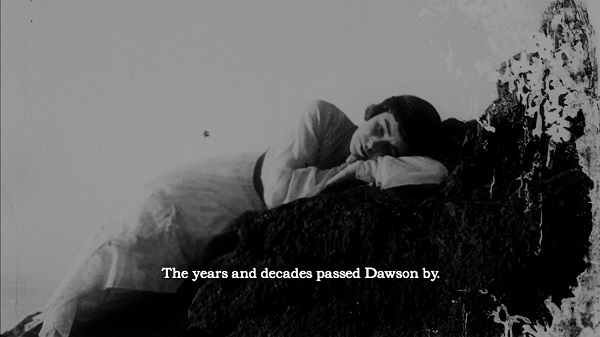 You can recognize the century-old films in Dawson City immediately. They’re in black and white, silent, blurry, shaky. And they’re fragile, with white scratches running through them like little veins, and full of holes. Next to them the aerial shot of present-day Dawson City, the camera embracing river and land to show exactly what it means to build a city where there wasn’t one before, looks like a space shuttle next to a wheelbarrow. That’s the point of Dawson City, to juxtapose old and new and make you think about time and memory. How quickly cinema ages, I’ve also thought. It’s a little older than one century and its beginnings already look ancient. Not so Greek prose of the first millennium. The words of Heliodorus and those of Psellus and Choniates many centuries later are made of the same stuff, which means the scenes from the novel blend into their surroundings without a glitch. In fact, whenever I spot one of them, I feel like I’ve seen through perfect camouflage. But maybe I’m wrong and these authors never intended to hide anything. Maybe the readers in Constantinople saw through the montage of old and new and drew a lot of pleasure from it. And I wonder, if we can recognize these scenes because we have the original to compare them to, how many scenes from lost novels are also there, undistinguishable from the rest but still floating somewhere?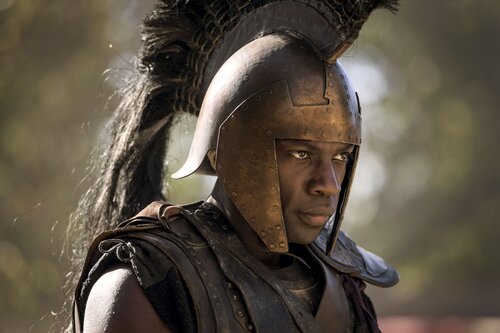
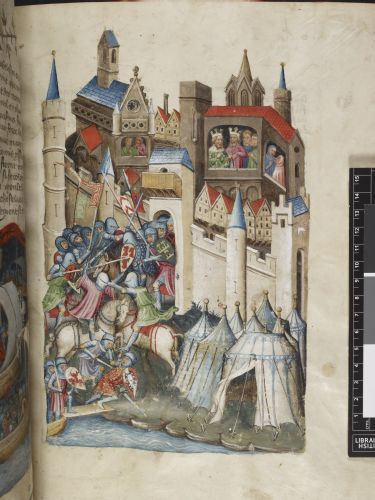 This is neither neutral nor innocent. Western medieval literature is known to use a clearly racial discourse at times: in stories about the crusades, for example, features such as a black skin characteristically portray non-Christians as Other; the ones to be defeated. The Seege, too, is a story about ‘East vs. West’, but with a twist: the ‘Eastern’ Trojans are supposed to be the ancestors of the medieval audience and thus ‘the good guys’. The Greeks are the enemies. With this in mind, it makes sense to a medieval audience that a narrator depicts the Greek Achilles as black: they would remember other stories and songs where the English knight defeats his black opponent (e.g. Guy of Warwick vs. the black giant Amoraunt)[4] and analogously recognize a black Achilles as ‘the enemy’ in the Seege. In the same fashion, witchcraft is easier to understand than the divine powers of an unknown pagan goddess. So the black skin – alongside his Muslim religion and mother’s witchcraft – is perhaps ‘just’ a narrative trick. The Seege also gives Achilles credit for his prowess. He is a strong fighter and more honest than several Trojans; a real champion. But the suggestion that he is
 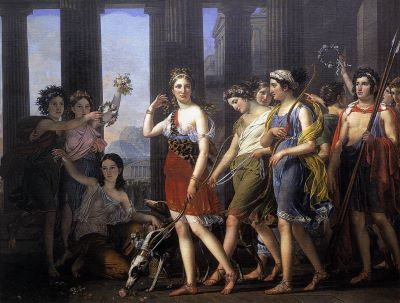 –Joseph Paelinck’s painting The Fair Anthia Leading her Companions to the Temple of Diana in Ephesus
 — Ellen’s father with face mask
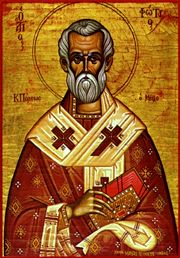 But Photius is not an infallible source. Some of the novels he describes are still extant, and by comparing the novel with Photius; version of it, we can see the differences. Heliodorus’ Aithiopika, likely written in the third or fourth century CE, is famously complicated and twisty. It starts enigmatically with two unknown figures left alive after the aftermath of a battle, and it takes roughly half of this 80,000 word novel to find out who these people are and what sparked this battle. The eleventh century Byzantine writer Michael Psellos comments on how twisty Heliodorus’ plot is, comparing it to snakes hiding their heads in their coils so you can’t see where they end or begin. Photius, however, doesn’t mention this at all. Instead, he begins the plot at the earliest chronological point of the story rather than the actual beginning of the book. This is not entirely wrong, but tells us something about Photius’ priorities that he reorders the complex plot into a chronologically linear fashion.